Viking Refrigerator Repair
Viking Refrigerator Leaking Water From the Bottom: Find the Source
A Viking refrigerator leaking water from the bottom usually has a clogged or frozen defrost drain, a cracked or shifted drain pan, or a leaking ice maker supply line. Dry the floor, see where water shows up first, and close the water valve if the line is wet.
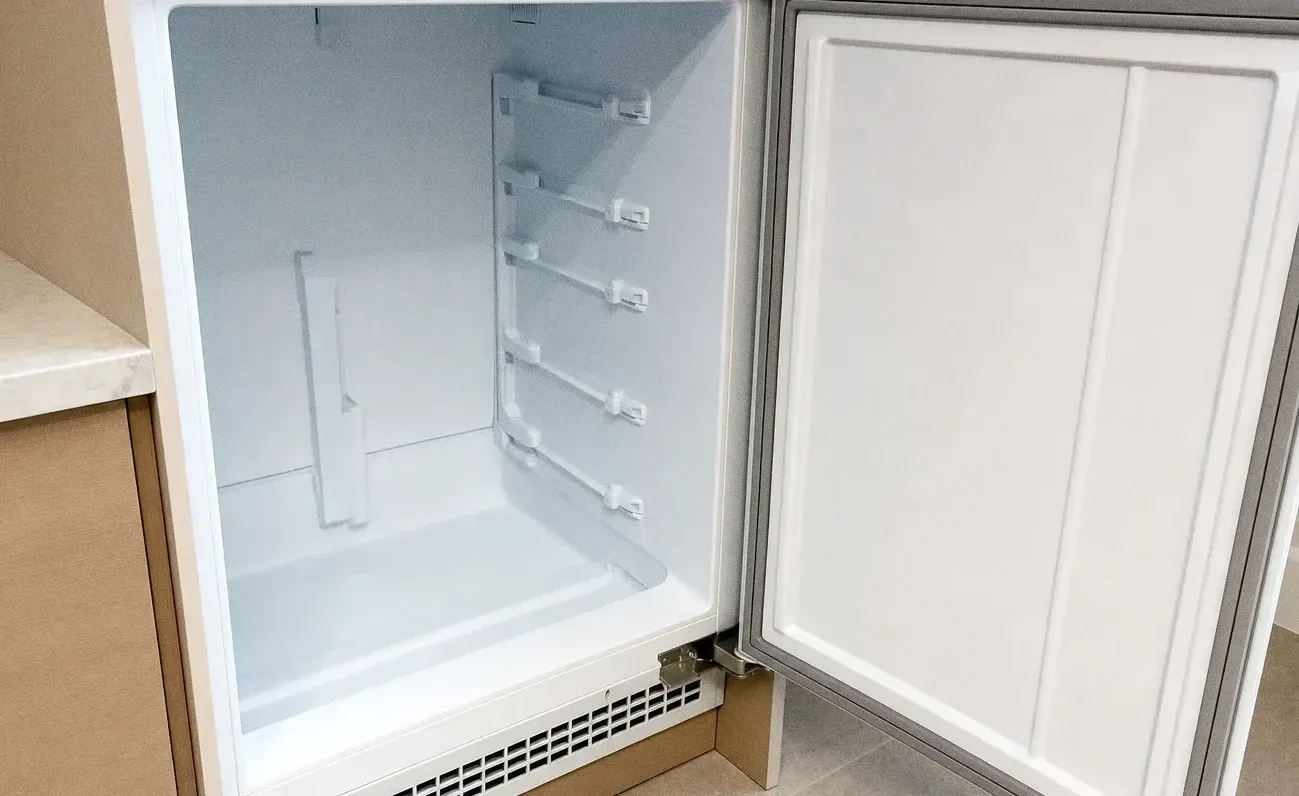
Water under a Viking refrigerator almost always comes from one of four places: the defrost drain that carries meltwater out of the cabinet, the shallow pan that catches it, the water line feeding the ice maker and dispenser, or condensation running off a door that no longer seals. You can usually tell which one in about ten minutes with a dry towel and a flashlight. Water that appears inside the fresh-food section first points to the drain. Water at the back or under the toe kick while the inside stays dry points to the supply line or the pan. If the floor is wet near the power cord or outlet, unplug the unit before anything else.
Speed matters. A slow drip can sit unseen under a built-in for weeks, and plenty of Boston kitchens have old plank floors that cup and stain once water works under the finish.
Trace the water before you guess
Start with a completely dry floor. Wipe everything up, then lay a strip of paper towel along the toe kick and, if you can reach, along each side of the cabinet. Check it after a few hours. Whichever part gets wet first tells you which side the water is traveling from.
Next, open the fresh-food door and pull out the crisper drawers. A sheet of ice on the rear panel, a puddle under the drawers, or water dripping off the drawer rails means defrost meltwater cannot leave the cabinet. It spills over inside and runs out under the door.
If the inside is dry, look outside. A drip at a back corner, or one that appears only after the dispenser is used or the ice maker refills, points to the water supply. Droplets beading on the doors on sticky summer days are condensation, a seal question rather than a plumbing one. If a dishwasher sits beside the refrigerator, rule it out too, since its leaks can spread sideways.
The defrost drain and the drain pan
A frost-free refrigerator warms its evaporator coil several times a day to melt the frost off it. That water runs down a trough, through a drain opening, and along a tube to a pan near the compressor, where warm air evaporates it. When crumbs, mold or a plug of ice block the opening, the water ends up on the shelves and the floor.
A soft clog is usually something you can clear yourself when the opening is visible. Unplug the refrigerator, move food to a cooler, and use a turkey baster to push warm water slowly into the drain. If it flows away, flush a little more to rinse the tube. Never chip at ice with a knife or screwdriver. The coil sits right there, and a punctured coil turns a cheap clean-out into a sealed-system repair.
The pan is the other half of that path. Depending on the model it sits behind the lower grille or up behind the top grille. A pan nudged out of place during cleaning, or one with a hairline crack, lets water reach the floor even with a clear drain. Look with a flashlight, but do not pull a built-in Viking out of its opening to reach it. Those units are heavy, anchored to the cabinetry, and easy to damage on the way out.
A drain that freezes shut again within weeks is a different problem. It usually means the defrost heater, its thermostat or the control running the cycle has failed, so the ice never fully melts. That refrigeration fan or defrost system repair typically falls between $300–$710, with the firm price set after diagnosis.
The water supply line and inlet valve
Viking models with an ice maker or dispenser are plumbed with a small supply line that usually ends at a shutoff under the sink, in the basement or in the next cabinet. The usual failure points are the compression fitting at the back of the refrigerator, a kinked or cracked plastic tube, and the inlet valve that sends water to the ice maker. These leaks come and go with the fill cycle, so the floor may be dry at breakfast and wet by dinner.
If the line is wet, close the shutoff and turn the ice maker off. A compression nut that has backed off can sometimes be snugged a quarter turn, but a weeping valve or a split tube should be replaced, not taped.
Door seals and condensation
Condensation shows up as droplets along the door edges or cabinet face, sometimes with a thin drip line below a door. Humid air reaches cold surfaces when a gasket is torn, flattened or folded, or when a jar on a shelf holds the door open slightly. To test the seal, shut a thin slip of paper in the door at the top, middle and bottom and tug it. Wherever it slides out with no resistance, the gasket is not gripping.
Wash the gaskets with warm soapy water, since sticky residue stops them seating, and check that the refrigerator is level side to side and tipped very slightly back so the doors swing shut on their own. A hardened or split gasket needs replacing.
When the leak needs a technician
Call for service when the leak returns after you have cleared the drain, when water reaches the controls or wiring, when the supply line leaks inside a wall or under the floor, or when the refrigerator is also running warm. A leak paired with weak cooling often means the defrost system has failed and frost is choking the coil.
Viking Repair Boston is an independent service that uses factory-approved parts on Viking built-in and freestanding refrigeration, including professional side-by-sides and integrated columns. We start with a $95 service call to find the cause, and once you say yes to the repair, those $95 come off the final bill. Read more about Viking refrigerator repair or call (617) 300-0906 to book. We cover homes in the North End, Ashmont, Roslindale and the Seaport District.
Still asked on the phone
Why is there water under the crisper drawers in my Viking refrigerator?
Water under the crispers almost always means the defrost drain is blocked by debris or ice, so meltwater from the defrost cycle overflows inside the cabinet instead of reaching the pan. Flushing the opening with warm water often clears it. If it freezes shut again within a few weeks, the defrost heater or its control probably needs a technician.
Can I keep using my Viking refrigerator while it leaks?
Usually yes for a short while, provided the water is nowhere near the power cord or outlet and you keep the floor dry. Close the water supply valve if the line is the source, turn off the ice maker, and wipe out the compartment floor every day until the repair is done.
Is a leaking Viking refrigerator worth repairing?
In most cases it is, because the usual causes are small parts rather than the sealed system. A defrost or fan repair typically lands in the $300–$710 range, far below the price of a new built-in, and the firm quote comes once the fault has been diagnosed.
What does it cost to have the leak diagnosed?
Diagnosis is covered by our $95 service call. That one charge gets a technician to your kitchen to find the cause, and if you approve the repair afterwards, the $95 is credited toward it rather than added on top.